1Smile Dental | Teeth Whitening, Sleep Apnea and Ceramic Crowns

Snap-in Dentures in Schererville, Indiana

Removable Dental Implants (Snap-In Dentures) in Schererville, NW IN

A More Stable, Implant-Supported Alternative to Traditional Dentures

If you’re dealing with loose dentures, difficulty chewing, or missing teeth, removable dental implants—also known as snap-in dentures or locator overdentures—offer a meaningful upgrade in stability, comfort, and function.

1Smile Dental | Snap-in Dentures, Bone Grafting and Digital Radiography

At 1Smile Dental, we treat patients from Munster, Dyer, St. John, Highland, Merrillville, Crown Point, and many who travel from Chicago for comprehensive implant care delivered under one roof.

This page will help you understand not just what snap-in dentures are—but how they function biomechanically, how they compare to fixed solutions, and when they are the right choice.

What Are Removable Dental Implants?

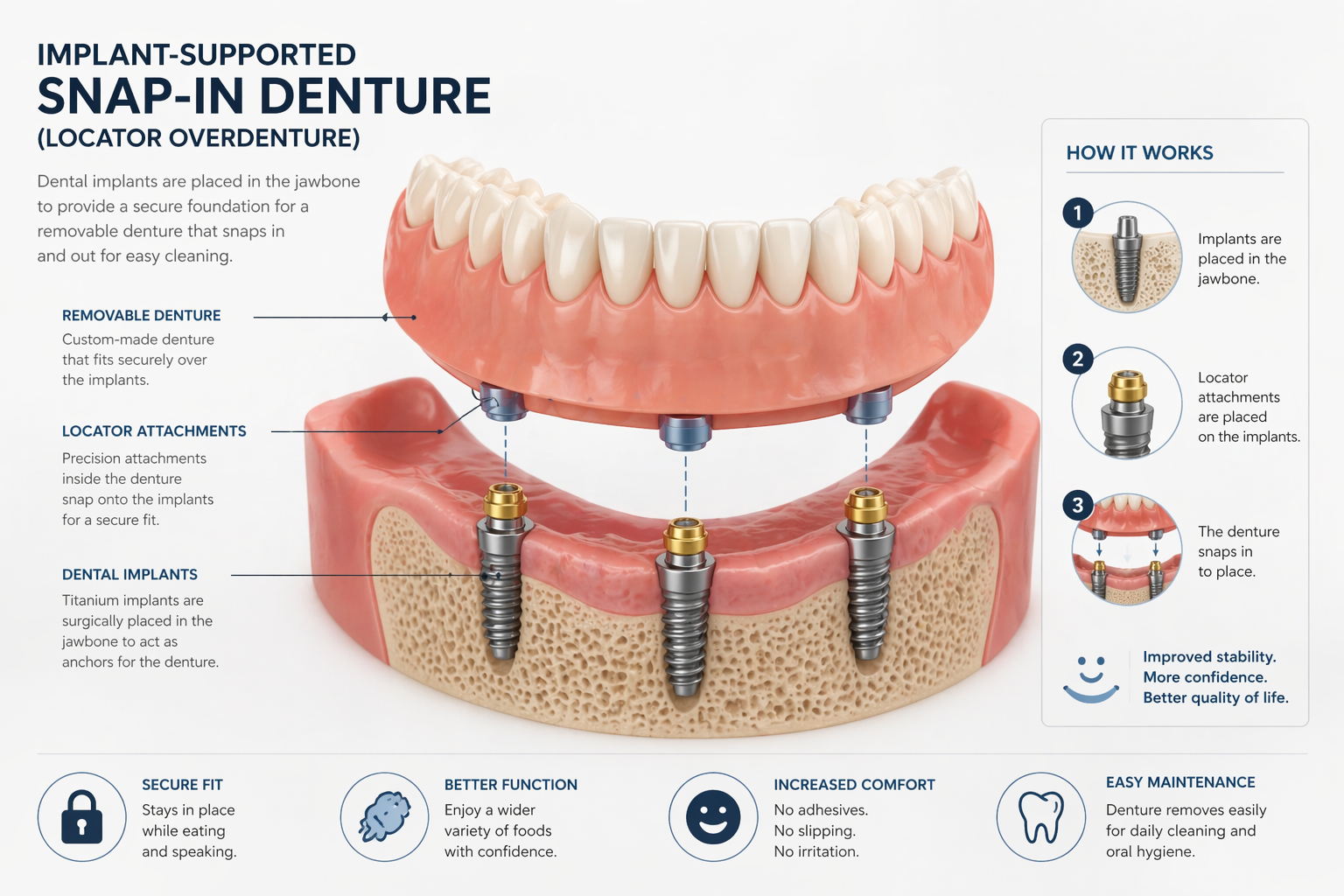
Removable dental implants are implant-supported overdentures that attach to dental implants using precision connectors called locator attachments.

Unlike traditional dentures—which rely on suction, adhesives, and soft tissue support—snap-in dentures are:

  • Mechanically retained by implants
  • More stable during function
  • Designed to reduce movement during speech and chewing
  • Still removable by the patient for hygiene

Learn more about dental implants

How Snap-In Dentures Work (Biomechanical Overview)

Endosseous Implants

Titanium implants are placed into the jawbone, where they undergo osseointegration—a biological process where bone fuses directly to the implant surface.

  • This creates a rigid anchor within the bone
  • Load is partially transferred from the denture to the implants

Locator Attachments

Locator abutments act as low-profile mechanical retention systems.

  • Nylon inserts within the denture engage the abutments
  • Retention strength can be adjusted based on patient needs
  • Designed to allow vertical resiliency with limited rotational movement

Overdenture Prosthesis

The denture sits on both the implants and the underlying soft tissue, creating a dual-support system:

  • Implant-supported (retention)
  • Tissue-supported (load distribution)

Learn more about dentures

Who Is a Good Candidate?

Snap-in dentures are often ideal for patients who:

  • Have complete or near-complete tooth loss
  • Struggle with traditional denture instability
  • Want improved retention without committing to a fixed prosthesis
  • Prefer a more cost-conscious entry into implant dentistry

Removable vs Fixed (All-on-X): A Clinical Comparison

Snap-In Dentures (Removable)

  • Supported by implants and soft tissue
  • Exhibit controlled movement under occlusal load
  • Lower maximum bite force
  • Require removal for hygiene

Fixed All-on-X Prosthesis

  • Fully implant-supported
  • Rigidly splinted across implants
  • Minimal micro-movement
  • Higher bite force capacity

Compare with All-on-X dental implants and All-on-4 options

Benefits of Snap-In Dentures

  • Improved retention compared to traditional dentures
  • Better chewing efficiency
  • Reduced pressure on soft tissue
  • Cost-effective entry into implant dentistry

Limitations and Clinical Tradeoffs

  • Controlled movement exists
  • Lower bite force compared to fixed solutions
  • Ongoing maintenance required
  • Locator inserts typically replaced every 6–18 months

The Role of Bone Quality and Volume

Implant success is directly tied to bone density and volume.

  • Bone height and width
  • Cortical vs trabecular composition

If bone is insufficient, additional procedures may be required.

Bone grafting for dental implants

Advanced Surgical Planning and Execution

We utilize:

  • 3D CBCT imaging
  • Digital treatment planning
  • Precision implant placement

What to Expect: Step-by-Step

Consultation and Diagnostics

  • CBCT imaging
  • Bone evaluation
  • Prosthetic planning

Implant Placement

  • Minimally invasive procedure
  • Healing phase for osseointegration

Prosthetic Fabrication

  • Custom denture design
  • Locator attachment integration

Final Delivery

  • Snap-in placement
  • Adjustments for comfort and retention

Daily Maintenance and Longevity

  • Remove and clean prosthesis daily
  • Clean around implant attachments
  • Attend routine maintenance visits

Cost Considerations

Costs vary based on:

  • Number of implants
  • Bone grafting needs
  • Prosthetic complexity

Areas We Serve

  • Schererville
  • Munster
  • Dyer
  • St. John
  • Highland
  • Merrillville
  • Crown Point
  • Chicago

Schedule Your Consultation

Choosing the right implant solution requires a detailed evaluation of your needs and long-term goals.

Schedule your consultation today

Removable Dental Implants (Snap-In Dentures) in Schererville, NW IN

A More Stable, Implant-Supported Alternative to Traditional Dentures

If you’re dealing with loose dentures, difficulty chewing, or missing teeth, removable dental implants—also known as snap-in dentures or locator overdentures—offer a meaningful upgrade in stability, comfort, and function.

At 1Smile Dental, we treat patients from Munster, Dyer, St. John, Highland, Merrillville, Crown Point, and many who travel from Chicago for comprehensive implant care delivered under one roof.

This page will help you understand not just what snap-in dentures are—but how they function biomechanically, how they compare to fixed solutions, and when they are the right choice.

What Are Removable Dental Implants?

Removable dental implants are implant-supported overdentures that attach to dental implants using precision connectors called locator attachments.

Unlike traditional dentures—which rely on suction, adhesives, and soft tissue support—snap-in dentures are:

  • Mechanically retained by implants
  • More stable during function
  • Designed to reduce movement during speech and chewing
  • Still removable by the patient for hygiene

Learn more about dental implants

How Snap-In Dentures Work (Biomechanical Overview)

Endosseous Implants

Titanium implants are placed into the jawbone, where they undergo osseointegration—a biological process where bone fuses directly to the implant surface.

  • This creates a rigid anchor within the bone
  • Load is partially transferred from the denture to the implants

Locator Attachments

Locator abutments act as low-profile mechanical retention systems.

  • Nylon inserts within the denture engage the abutments
  • Retention strength can be adjusted based on patient needs
  • Designed to allow vertical resiliency with limited rotational movement

Overdenture Prosthesis

The denture sits on both the implants and the underlying soft tissue, creating a dual-support system:

  • Implant-supported (retention)
  • Tissue-supported (load distribution)

Learn more about dentures

Who Is a Good Candidate?

Snap-in dentures are often ideal for patients who:

  • Have complete or near-complete tooth loss
  • Struggle with traditional denture instability
  • Want improved retention without committing to a fixed prosthesis
  • Prefer a more cost-conscious entry into implant dentistry

Removable vs Fixed (All-on-X): A Clinical Comparison

Snap-In Dentures (Removable)

  • Supported by implants and soft tissue
  • Exhibit controlled movement under occlusal load
  • Lower maximum bite force
  • Require removal for hygiene

Fixed All-on-X Prosthesis

  • Fully implant-supported
  • Rigidly splinted across implants
  • Minimal micro-movement
  • Higher bite force capacity

Compare with All-on-X dental implants and All-on-4 options

Benefits of Snap-In Dentures

  • Improved retention compared to traditional dentures
  • Better chewing efficiency
  • Reduced pressure on soft tissue
  • Cost-effective entry into implant dentistry

Limitations and Clinical Tradeoffs

  • Controlled movement exists
  • Lower bite force compared to fixed solutions
  • Ongoing maintenance required
  • Locator inserts typically replaced every 6–18 months

The Role of Bone Quality and Volume

Implant success is directly tied to bone density and volume.

  • Bone height and width
  • Cortical vs trabecular composition

If bone is insufficient, additional procedures may be required.

Bone grafting for dental implants

Advanced Surgical Planning and Execution

We utilize:

  • 3D CBCT imaging
  • Digital treatment planning
  • Precision implant placement

What to Expect: Step-by-Step

Consultation and Diagnostics

  • CBCT imaging
  • Bone evaluation
  • Prosthetic planning

Implant Placement

  • Minimally invasive procedure
  • Healing phase for osseointegration

Prosthetic Fabrication

  • Custom denture design
  • Locator attachment integration

Final Delivery

  • Snap-in placement
  • Adjustments for comfort and retention

Daily Maintenance and Longevity

  • Remove and clean prosthesis daily
  • Clean around implant attachments
  • Attend routine maintenance visits

Cost Considerations

Costs vary based on:

  • Number of implants
  • Bone grafting needs
  • Prosthetic complexity

Areas We Serve

  • Schererville
  • Munster
  • Dyer
  • St. John
  • Highland
  • Merrillville
  • Crown Point
  • Chicago

Schedule Your Consultation

Choosing the right implant solution requires a detailed evaluation of your needs and long-term goals.

Schedule your consultation today

Frequently Asked Questions

Are snap-in dentures better than traditional dentures?

+
Yes. Snap-in dentures are supported by dental implants, which significantly improves stability, comfort, and chewing ability compared to traditional dentures.

How many implants are required for snap-in dentures?

+
Most patients require between 2 and 4 implants per arch, depending on bone structure and treatment goals.

Do snap-in dentures move?

+
There is some controlled movement because they are supported by both implants and soft tissue, but they are much more stable than traditional dentures.

How long do locator attachments last?

+
Locator attachments typically last between 6 and 18 months depending on wear, usage, and maintenance.

Can snap-in dentures be converted to a fixed solution later?

+
In many cases, yes. Patients may be able to upgrade to a fixed implant solution depending on bone availability and implant positioning.

Contact Us

We would be happy to answer any questions you have. Just fill out the contact form below and we'll get back to you as soon as possible.

Submit

Call Us

Visit Us

41 US Highway 41
Schererville, IN 46375

Contact Us

Submit